Call: +1 212-972-1212 Open Hours: Mon-Friday 9:00 am-6:00 pm
Afghanistan Elected Vice-President of the 81st Session of the United Nations General Assembly
New York, 2 June 2026 – The United Nations General Assembly today elected the President, Vice-Presidents, and Bureau members of its 81st session.
The General Assembly elected H.E. Dr. Khalilur Rahman of Bangladesh as President of the 81st session of the United Nations General Assembly (UNGA 81). Afghanistan extends its warm congratulations to Bangladesh and President-elect Dr. Khalilur Rahman and wishes him every success in leading the work of the General Assembly during the upcoming session.
Afghanistan is honored to have been elected as one of the Vice-Presidents of the 81st session of the General Assembly. This election reflects the continued confidence of Member States in Afghanistan’s constructive engagement within the United Nations and its commitment to the principles and purposes of the UN Charter.
As Vice-President of the 81st session, Afghanistan looks forward to working closely with the President-elect, fellow Vice-Presidents, and all Member States in advancing the priorities of the General Assembly and strengthening multilateral cooperation in support of international peace, security, sustainable development, and human rights.
The Permanent Mission of Afghanistan to the United Nations remains committed to contributing actively and responsibly to the work of the General Assembly and to ensuring that the voices and aspirations of the Afghan people continue to be represented within the United Nations.
UNAMA Statement on the Arrest of Women in Herat and Taliban Use of Force Against Protesters
10 June 2026
KABUL – UNAMA is deeply concerned by the arrest of at least 30 women in Herat city between 6 and 7 June by de facto Propagation of Virtue and Prevention of Vice officials, together with de facto Police, for allegedly violating dress code instructions.
Dozens more women reportedly received verbal warnings. While the women were released on 8 June, the impact of such arbitrary arrests and detentions on women and their families is profound.
UNAMA is also alarmed by the excessive use of force by Afghanistan’s de facto security forces against residents who gathered in the Jibreil area of Herat city on 9 June to protest the arbitrary detentions. UNAMA has confirmed that at least one person, a boy, was killed by gunfire, while several others suffered injuries including from being beaten with sticks, and is verifying reports of a second fatality.
“A woman’s detention in Afghanistan carries enormous stigma, which can put women at risk of further violence and isolation in their families and communities even after they are released,” said the Secretary-General’s Deputy Special Representative for Afghanistan and Officer-in-Charge for UNAMA, Georgette Gagnon.
“The de facto authorities are obliged under international law to uphold the rights of all Afghans to freedom of expression, peaceful assembly, liberty and security of person, and freedom from arbitrary detention,” said Ms. Gagnon.
UNAMA reiterates that all law enforcement measures must comply with international legal standards, including the principles of necessity, proportionality and non-discrimination in the use of force. Individuals have the right to express dissent peacefully without fear of violence, intimidation or reprisals.
UNAMA reinforces its call on the de facto authorities to rescind all policies and practices that restrict the human rights and fundamental freedoms of women and girls in Afghanistan, including restrictions on freedom of movement, expression, education, employment and participation in public life.
UN Experts condemn arrests for dress code violations and excessive use of force in Herat
11 June 2026
GENEVA – UN experts* today expressed deep concern about reports of excessive use of force against demonstrators protesting restrictive measures after dozens of women were detained for alleged dress code violations in Herat, Afghanistan, on 6 and 7 June 2026.
“Use of force in law enforcement is strictly restricted under international law,” the experts said. “It is permitted only when it is legal, necessary and proportionate to the threat posed to officers or to others, and when it respects principles of precaution, non-discrimination and accountability.”
“As the de facto authority in Afghanistan, the Taliban must comply with the international human rights treaties to which Afghanistan is a party, including the International Covenant on Civil and Political Rights, the Convention against Torture and the Convention on Elimination of All Forms of Discrimination against Women.”
On 9 June 2026, people gathered in Herat to protest increasingly repressive restrictions and the detention of dozens of women for allegedly violating an order to restrict women’s attire, including requirements to wear a burka or chador with a face mask and a ban on perfume. De facto authority officials allegedly opened fire on protesters – men, women and children – and beat them. At least two people, including a boy, were killed and more than twenty were injured. The experts noted reports of stone-throwing by some protesters, but stated that such actions would not, in themselves, meet the strict threshold for the use of lethal force.
“Allegations that women were detained for dress code violations are deeply concerning and may constitute arbitrary and unlawful detention, as it appears to penalise the exercise of their right to freedom of expression and right to be free from gender discrimination,” they said.
The experts urged the Taliban to conduct an investigation promptly, effectively, independently, impartially and transparently into the use of forces by officials. Such investigations must be capable of establishing whether the use of lethal force was strictly necessary and proportionate to protect life, securing forensic evidence from the outset and ensuring accountability for those responsible and their chain of command.
“Equality, peaceful assembly, freedom of expression and movement, and protection from arbitrary detention are fundamental rights essential to restoring public confidence and preventing further deterioration of the situation,” they said.
They stressed that the exercise of law enforcement powers must remain strictly consistent with the principles of legality, necessity, proportionality and non-discrimination, and fully aligned with Afghanistan’s obligations under international human rights law.
The experts urged de-escalation and warned that tensions must be reduced immediately to prevent further violence or harm.
They called on the Taliban to immediately release detainees, including women arrested for dress code violations and protesters, strictly avoid ill-treatment, refrain from any actions or rhetoric that prevent people with injuries from accessing medical care and stop searching people’s houses.
WHO Emergency Situation Report Highlights Ongoing Health Challenges in Afghanistan
The World Health Organization (WHO) has released its Emergency Situation Report No. 62 (March 2026), providing an updated overview of the public health situation and ongoing humanitarian health response in Afghanistan.
The report highlights the continued delivery of essential health services across the country, despite significant operational and environmental challenges. During the reporting period, WHO and its partners distributed over 200 essential medical kits, reaching more than 800,000 beneficiaries, and supported a wide range of primary healthcare services.
The epidemiological situation remains complex. While cases of acute respiratory infections declined compared to the previous month, increases were recorded in malaria and other communicable diseases. The report also notes the persistence of serious health threats, including Crimean–Congo hemorrhagic fever, with a relatively high fatality rate.
In addition to disease trends, the report underscores the impact of natural disasters and displacement on the health system. Heavy rains and flash floods during the reporting period displaced thousands of families, caused civilian casualties, and disrupted health services in multiple facilities.
WHO-supported health facilities continued to provide critical services, including outpatient consultations, maternal and child healthcare, vaccination campaigns, and mental health support. Notably, thousands of individuals received mental health consultations, reflecting the growing need for psychosocial services in the country.
The report further highlights the health needs of returnees entering Afghanistan through key border points, emphasizing the importance of disease screening and continuity of care amid ongoing population movements.
Overall, the findings reflect both the resilience of health service delivery systems and the persistent vulnerabilities facing Afghanistan’s public health sector, including disease outbreaks, natural disasters, and resource constraints.
The Permanent Mission of Afghanistan reiterates the importance of sustained international support for the health sector and emphasizes that ensuring access to essential healthcare services remains critical for the well-being and dignity of the Afghan people.
The full report is available here:
👉 https://www.emro.who.int/images/stories/afghanistan/emergency_situation_report_62_march_2026.pdf
UN Releases 2025 Afghanistan Annual Results Report
New York | 15 April 2026
The United Nations has released the 2025 Afghanistan Annual Results Report, providing an overview of the Organization’s engagement and activities across humanitarian, development, and human rights pillars during the past year.
The report outlines key developments on the ground, including the continued humanitarian needs of the Afghan people, the operational challenges faced by UN agencies, and the broader socio-economic conditions affecting the country. It also highlights ongoing efforts to deliver life-saving assistance, support basic services, and maintain engagement with the Afghan population under complex and constrained circumstances.
Particular attention is given to the situation of women and girls, whose access to education, employment, and public life remains severely restricted. The report underscores the importance of sustained international support to ensure that essential services, protection mechanisms, and humanitarian operations continue to reach those most in need.
The findings further reflect the broader challenges facing Afghanistan, including economic fragility, food insecurity, and the need for coordinated international engagement to address long-term stability and development.
The Permanent Mission of Afghanistan reiterates the importance of continued international attention to the situation in Afghanistan and emphasizes that the needs and rights of the Afghan people, particularly women and youth, must remain at the center of all efforts.
The full report is available here:
👉 https://afghanistan.un.org/en/313178-2025-un-afghanistan-annual-results-report
UN Security Council Meeting on the Situation in Afghanistan
9 March 2026 | United Nations Headquarters, New York
The United Nations Security Council convened on 9 March 2026 to discuss the situation in Afghanistan, focusing on recent political, humanitarian, and security developments, as well as the implementation of the mandate of the United Nations Assistance Mission in Afghanistan (UNAMA).
Briefings to the Council highlighted the continued deterioration of the human rights situation, particularly for women and girls, alongside persistent humanitarian challenges and growing concerns over security and stability. The Council was also updated on the implementation of ongoing international engagement efforts, including follow-up to recent UN-led initiatives aimed at advancing a more coherent and structured approach to Afghanistan.
In his statement, H.E. Mr. Naseer Ahmad Faiq, Chargé d’Affaires of the Permanent Mission of Afghanistan to the United Nations, underscored that the current trajectory in Afghanistan remains deeply concerning. He reiterated that the systematic exclusion of women and girls from education, employment, and public life continues to represent one of the most pressing human rights crises globally.
He emphasized that meaningful progress in Afghanistan requires placing a credible and inclusive political process at the center of international efforts. In this regard, he called for a United Nations-facilitated, inclusive intra-Afghan dialogue that reflects the will and aspirations of all segments of Afghan society, including women and youth.
Addressing security concerns, Mr. Faiq noted that the presence and activities of terrorist groups remain a serious threat, both within Afghanistan and to regional and international peace and security. He stressed the importance of sustained international attention to counterterrorism efforts, while ensuring that such measures are aligned with international law and do not come at the expense of the rights and well-being of the Afghan people.
He further highlighted the importance of a balanced and effective implementation of UNAMA’s mandate across its political, human rights, and humanitarian pillars, including robust monitoring and reporting on the situation of women and girls.
Council members expressed a range of views, but broadly reiterated concerns over the humanitarian situation, the erosion of fundamental rights, and the need for continued international engagement. Many emphasized that progress on human rights, particularly the rights of women and girls, remains essential to any path toward stability and normalization.
The meeting reaffirmed the continued engagement of the Security Council on Afghanistan and underscored the importance of a coordinated international approach to addressing the country’s complex and evolving challenges.
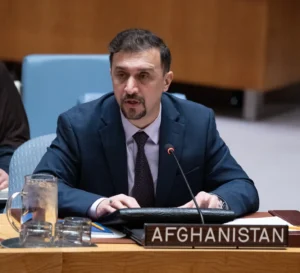
Radicalization of Education in Afghanistan: Implications for Justice, Peace and Security
11 March 2026 | United Nations Headquarters
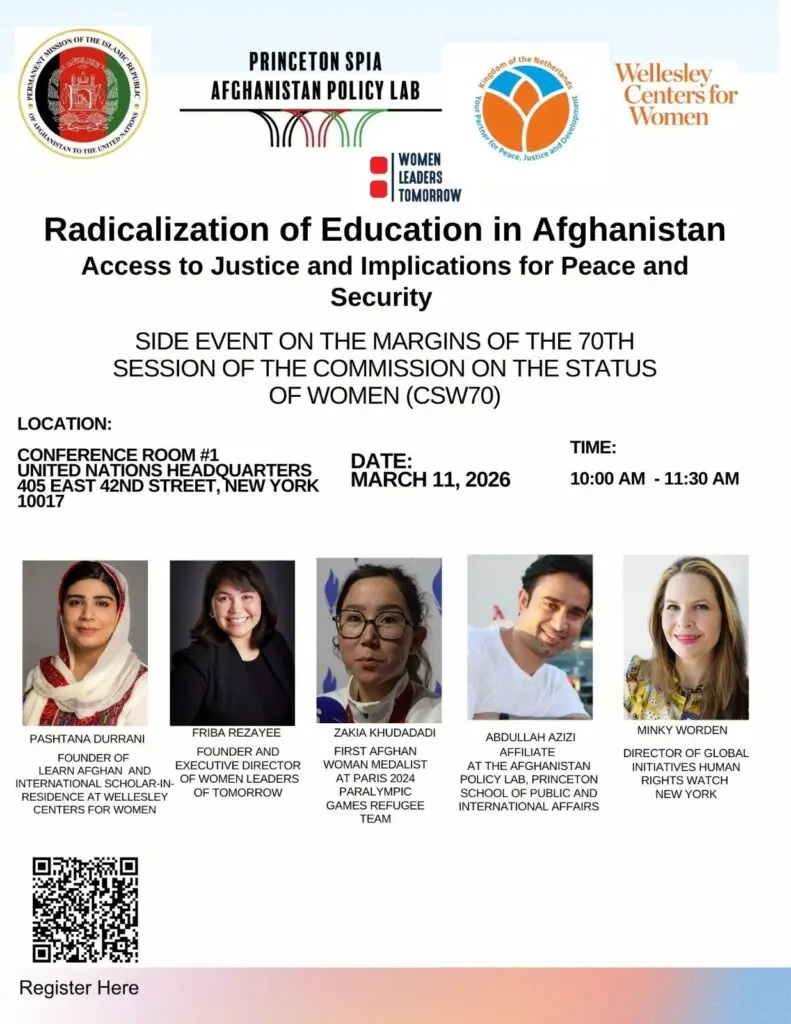
The Permanent Mission of Afghanistan to the United Nations, in partnership with the Permanent Mission of the Kingdom of the Netherlands and leading academic and civil society organizations, convened a high-level side event on the margins of the 70th session of the Commission on the Status of Women (CSW70), entitled “Radicalization of Education in Afghanistan: Access to Justice, and Implications for Peace and Security.”
The event brought together policymakers, experts, and advocates to examine the profound impact of education policies in Afghanistan on women’s rights, access to justice, and long-term peace and stability. Discussions highlighted that since August 2021, the systematic exclusion of women and girls from education and public life has not only deepened inequality but has also undermined social cohesion and future development prospects.
Participants underscored that Afghanistan remains the only country in the world where girls are banned from secondary and higher education, affecting millions of young women. At the same time, concerns were raised regarding the expansion of narrowly focused religious education systems and significant changes to curricula, including the reduction of modern and rights-based subjects. These developments were identified as contributing to the erosion of critical thinking, limiting opportunities for youth, and posing long-term risks to peace and security.
Speakers emphasized that education is not only a fundamental human right but also a cornerstone of justice, inclusion, and sustainable peace. The discussion further explored how the radicalization of education structures may entrench discrimination, restrict civic participation, and contribute to cycles of marginalization and instability.
At the same time, the event highlighted the resilience of Afghan women and youth, particularly through alternative and digital education initiatives. Panelists noted that online learning platforms and community-based approaches have emerged as vital lifelines, enabling continued access to education despite severe restrictions. However, these efforts remain under-resourced and require stronger international support and coordination.
The panel featured distinguished speakers, including Ms. Friba Rezayee, Ms. Pashtana Durrani, Mr. Abdullah Azizi, and Ms. Zakia Khudadadi, and was moderated by Ms. Minky Worden of Human Rights Watch. Their contributions provided diverse perspectives on education, human rights, youth empowerment, and the role of international engagement in addressing the crisis.
Participants called for sustained international attention, greater investment in alternative education pathways, and strengthened policy and accountability measures to ensure that Afghan women and girls are not excluded from global commitments under the Beijing Platform for Action and the 2030 Agenda.
The event reaffirmed that ensuring access to inclusive, quality education is essential not only for advancing gender equality, but also for promoting peace, stability, and long-term development in Afghanistan.
Ensuring Access to Justice for Afghan Women and Girls
12 March 2026 | United Nations Headquarters
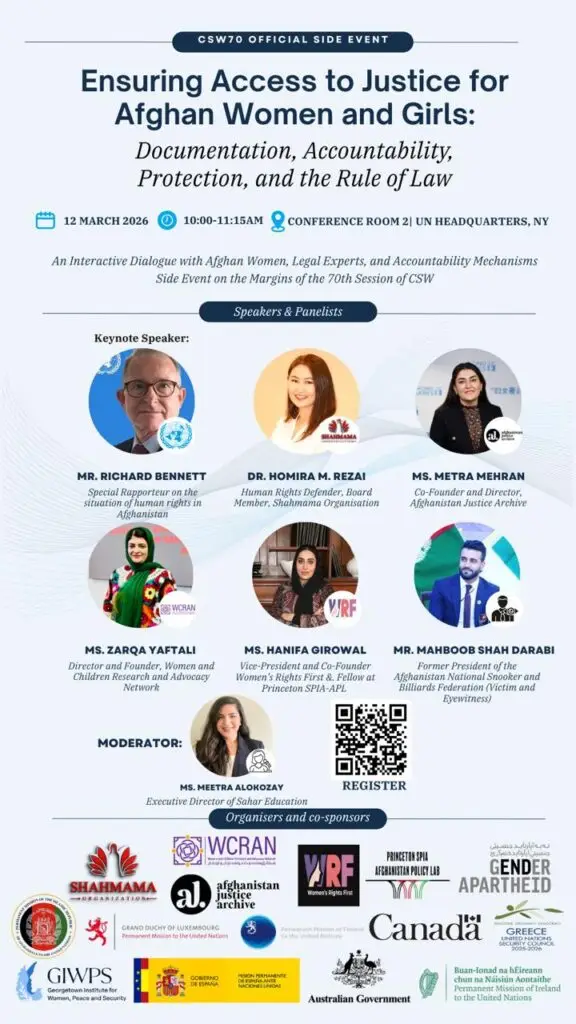
The Permanent Mission of Afghanistan to the United Nations, in collaboration with a group of Member States and civil society partners, convened a high-level side event on the margins of the 70th session of the Commission on the Status of Women (CSW70), entitled “Ensuring Access to Justice for Afghan Women and Girls: Documentation, Accountability, Protection, and the Rule of Law.”
The event brought together Afghan women leaders, legal experts, UN representatives, and Member States to examine the rapidly deteriorating access to justice for women and girls in Afghanistan. Participants highlighted how, since 2021, institutional and legal frameworks have been systematically dismantled and replaced with discriminatory policies that restrict women’s rights, legal status, and access to protection and redress.
In his opening remarks, H.E. Mr. Naseer Ahmad Faiq, Chargé d’Affaires of Afghanistan, underscored that Afghan women today face not only exclusion from public life but also the erosion of legal safeguards essential for justice and accountability. He emphasized that access to justice must be understood broadly, encompassing not only legal remedies but also physical safety, dignity, and the ability to exercise fundamental rights.
The keynote address was delivered by Mr. Richard Bennett, United Nations Special Rapporteur on the situation of human rights in Afghanistan, who provided an overview of the current human rights landscape and the urgent need for sustained international attention and accountability.
The panel discussion featured prominent Afghan experts and advocates who addressed critical issues including the codification of discriminatory laws, barriers to legal protection, and the impact of these policies on women’s health, autonomy, and access to services. Speakers also highlighted the importance of documenting violations and preserving evidence to support future accountability processes.
Participants emphasized that Afghan women are not a homogenous group, and that discrimination is often compounded by factors such as ethnicity, religion, socio-economic status, and geography. The discussion underscored the need for survivor-centered approaches and inclusive accountability mechanisms.
The event concluded with strong engagement from Member States, who reaffirmed the importance of supporting international accountability efforts and ensuring that the voices of Afghan women remain central in global policy discussions.
Co-sponsors included the Permanent Missions of Finland, Luxembourg, Canada, Spain, Australia, Ireland, and Greece, alongside key civil society organizations working on documentation and accountability.
17 March 2026
Last night’s tragic blast at a drug rehabilitation centre in Kabul, that reportedly left scores of patients dead, must be investigated promptly, independently and transparently, and those responsible held to account in line with international standards. Those results must be made public. Victims and victims’ families are entitled to reparations.
Witnesses described a scene of total destruction at the hospital site, and seeing hundreds of people looking for their relatives.
Under international humanitarian law, civilians and civilian objects are strictly protected. The laws of war clearly spell out that any attack must comply with the fundamental principles of distinction, proportionality and precautions. International humanitarian law provides for specific and increased protections for medical facilities.
Since the hostilities between Pakistan and Afghanistan escalated at the end of last month, 289 Afghan civilians, including 104 children and 59 women, have been killed or injured. Tens of thousands, mostly in the south and southeast of the country, have been displaced by the fighting.
In Pakistan, many have also been forced to flee their homes and schools have been closed.
UN High Commissioner for Human Rights Volker Türk reiterates his call on all parties to take effective measures to ensure the protection of civilians, in line with their obligations under international human rights law and international humanitarian law. He calls for an immediate end to hostilities, and for all parties to ensure humanitarian aid reaches those desperately in need.